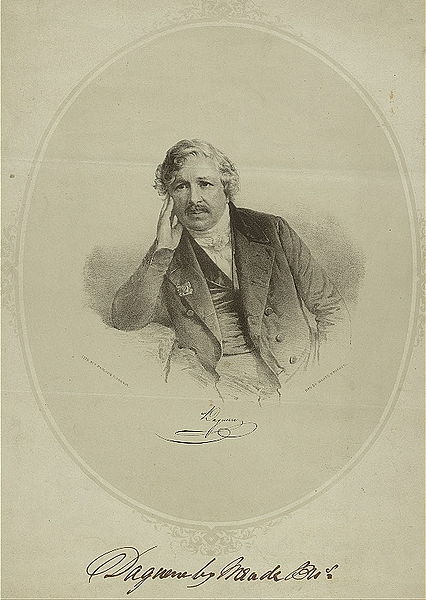
Louis Jacques Mande DAGUERRE (1787-1851)

The daguerreotype process was the first practicable method of obtaining permanent images with a camera. The man who gave his name to the process and perfected the method of producing direct positive images on a silver-coated copper plate was Louis Jacques Mande Daguerre, a French artist and scenic painter. Daguerre had began experimenting with ways of fixing the images formed by thecamera obscura around 1824, but in 1829 he entered into partnership with Joseph Nicephore Niepce(1765-1833), a French amateur scientist and inventor who, in 1826, had succeeded in securing a picture of the view from his window by using a a camera obscura and a pewter plate coated with bitumen. Niepce called his picture-making process heliography ("sun drawing"), but although he had managed to produce a permanent image using a camera, the exposure time was around 8 hours. Niepce later abandoned pewter plates in favour of silver-plated sheets of copper and discovered that the vapour from iodine reacted with the silver coating to produce silver iodide, a light sensitive compound.

After the death of Niepce in 1833, Daguerre continued to experiment with copper plates coated with silver iodide to produce direct positive pictures. Daguerre discovered that the latent image on an exposed plate could be brought out or "developed" with the fumes from warmed mercury. The use ofmercury vapour meant that photographic images could be produced in twenty to thirty minutes rather than hours. In 1837, Daguerre found a way of "fixing" the photographic images with a solution of common salt. Two years later, he followed the suggestion of Sir John Herschel (1792-1871) and adopted hyposulphate of soda (now thiosulphate of soda ) as the fixing agent.
Daguerre began making successful pictures using his improved process from 1837. On 19th August,1839, at a meeting in Paris, the Daguerreotype Process was revealed to the world.
In England, Richard Beard (1801-1885), a former coal merchant and patent speculator, bought the patent to Alexander Wolcott's mirror camera and employed the services of John Frederick Goddard (1795-1866), a chemist, to find a way of reducing exposure times to less than a few minutes, thereby making it possible to take daguerreotype portraits. On 23rd March 1841, Richard Beard opened England’s first daguerreotype portrait studio in London's Regent Street. In June 1841, Beard purchased from Daguerre the patent rights to the daguerreotype process in England.
Ten Steps in Making a Daguerreotype Process
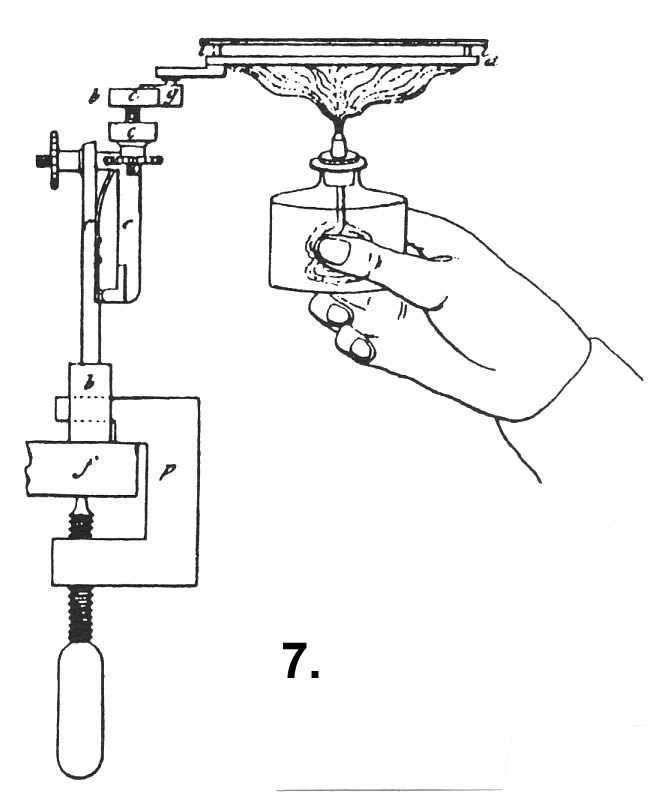
1. Polishing and Buffing the Photographic Plate
A plate of silver-coated copper is cleaned and highly polished with a soft cloth, using pumice powder and oil. The plate is continually polished and buffed until the silvered surface has a mirror-like brilliance.
2. Sensitizing the Photographic Plate
The polished plate is sensitized by exposing it to iodine and bromine fumes. The plate is first suspended in an air tight compartment containing chloride of iodine until the surface of the silvered plate turns yellow. The iodized plate is then suspended face down over chloride of bromine fumes. The two chemicals combine with the silver coating of the plate to form a light sensitive surface. ( Some daguerreotype artists used a combination of chlorine and iodinevapours ).
3. Loading the Camera
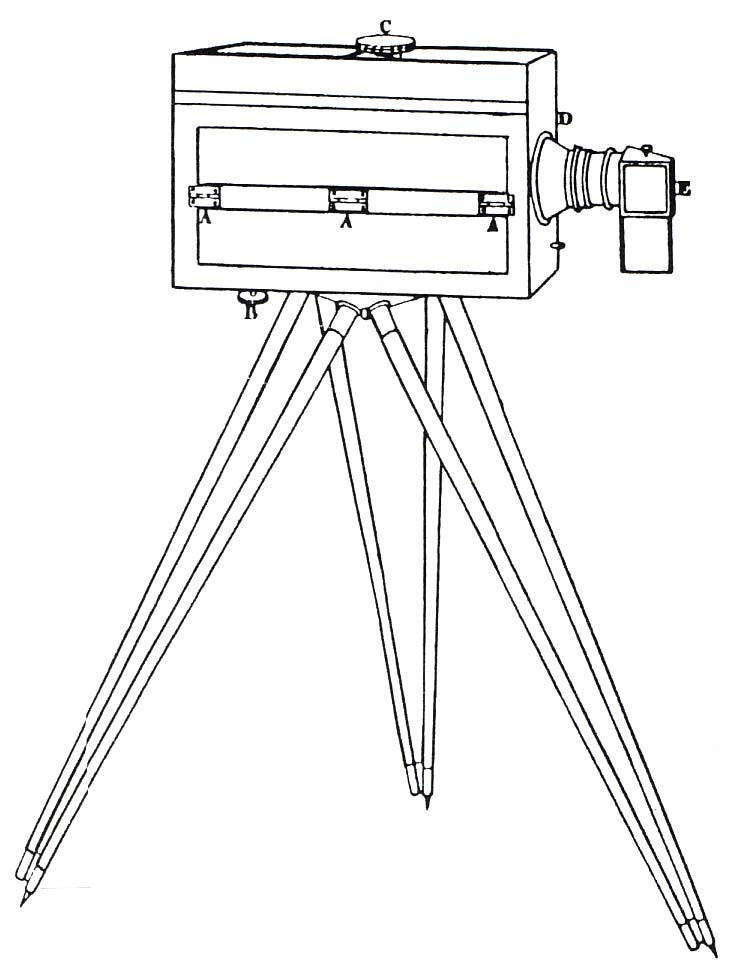
The sensitized plate is inserted into alight-proof holder with a protective slide and placed inside the camera.
4. Taking the Likeness
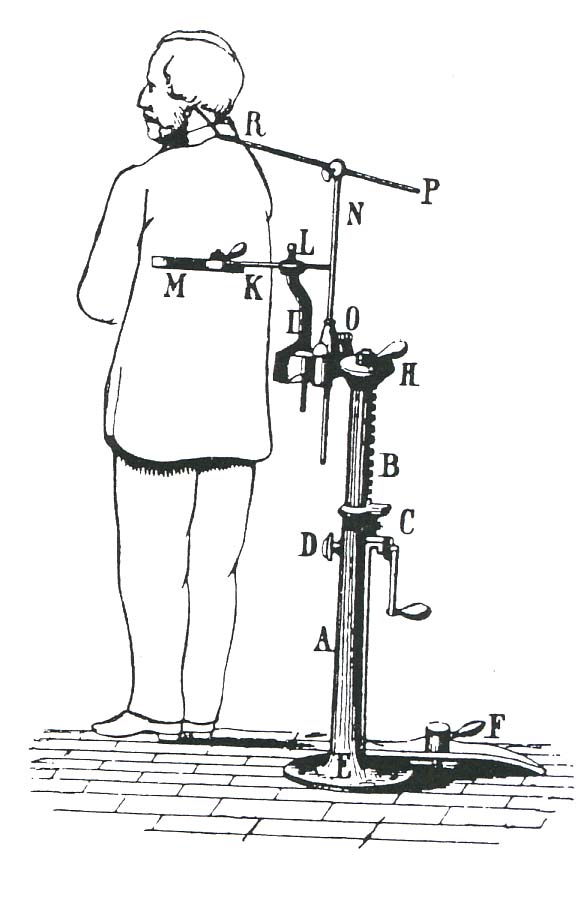
The subject is placed in front of the camera. If necessary, the pose is held with the assistance of adjustable head rests, clamps and posing stands.
The protective slide is removed and, when the photographer is satisfied with the pose and expression of the sitter, the lens cap is removed for a period of time until the image is captured on the sensitized surface of the plate.
5. Developing the Image
The image is "brought out" by suspending the photographic plate over a dish of mercury inside afuming box. The mercury is heated by a spirit lamp and the fumes from the mercury combine with the silver salts to produce a clear image on the plate.
6. Fixing the Image
 |
| Fixing the image with hyposulphate of soda |
The photographic image is made permanent by bathing the photographic plate in hyposulphate of soda ( or sodium thiosulphite ).
7. Gold Toning or Gilding ( optional )
The image on the the photographic plate can also be toned and strengthened by treating the plate with gold chloride
8. Washing the Photographic Plate
Finally, the photographic plate is washed in distilled water and dried.
9. Colouring ( optional )
The portrait could be coloured by hand. The surface of the plate was coated with a thin film of gum arabic and left to dry. The colourist would then breathe on the treated plate to make it sticky and with a fine paintbrush applied dry powdered pigment to the image.
 |
| A hand-coloured daguerreotype portrait of a woman by William Edward Kilburn, who opened a studio in Regent Street, London in 1846. William Kilburn was famous for his hand-coloured daguerreotype portraits, which were compared to painted portrait miniatures. |
10. Mounting and Presenting the Finished Daguerreotype Portrait
The finished daguerreotype portrait was surrounded by a gilt or brass mat, covered with a sheet of protective glass, and bound in a metal frame. The daguerreotype portrait was presented in a velvet or plush-lined, leather case, or mounted in a decorative frame.