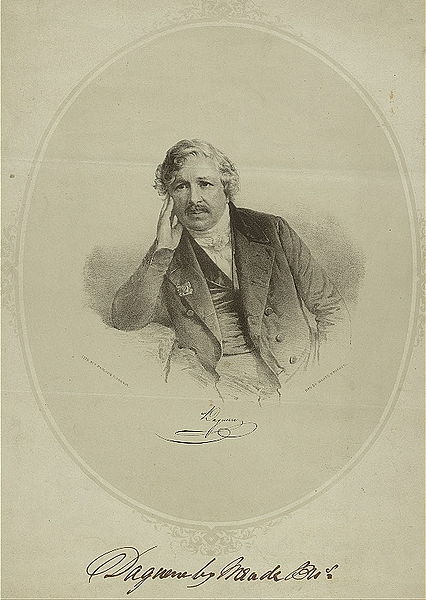
Google welcomed users with a family photo doodle in honour of Louis-Jacques-Mandé Daguerre's 224th birthday. The French painter and physicist was the inventor of daguerreotype, the first successful form of photography.
Before the daguerreotype, photography required hours of exposure and Louis Daguerre's invention reduced it to 20-30 minutes.
In the daguerreotype process, a technique developed by Daguerre in collaboration with Nicephore Niepce in the 1830s, a silver iodide coated copper plate was exposed to light in a camera and then was fumed with mercury vapour. Then a solution of common salt was applied to form a permanent image. As the daguerreotype grew popular, later improvements shortened the exposure time to forty seconds by 1841.

Born on November 18, 1787 in Cormeilles-en-Parisis, France, Daguerre learned architecture, theatre design, and painting. He along with De Dion-Bouton invented the diorama, a scenic painting within a box that when viewed through a peephole, changes color and direction of light to simulate changes in the weather, time of day, etc. In 1839 Daguerre's Diorama was destroyed in a fire.
Daguerre died of a heart attack on July 10, 1851.
The Daguerre Google doodle shows a family of five in a 19th century style family photo, where the 'G' and 'O' of the Google name depict the father and the mother and the remaining three letters the children. The 'Os' are the two daughters and 'E' the son. The 'L' is the lamp. Interestingly the father 'G' bears a resemblance to Daguerre himself.
Google doodles have gained immense popularity over the past few years and the Google team has put out commemorative doodles on events ranging from news events, civic milestones, birthdays, death anniversaries and important dates in history.
Google estimates it has created more than 900 doodles since 1998, with 270 of them running in 2010 and about 200 in 2011.