 |
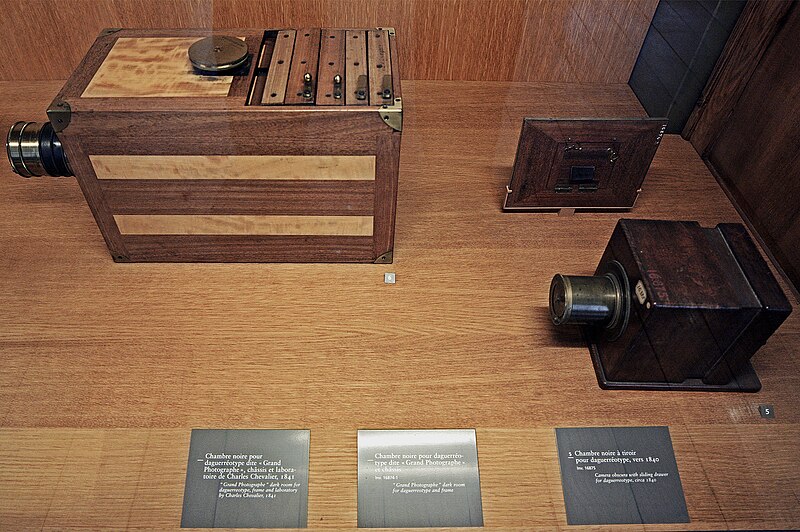
| 1840-1841 Camerae obscurae and plates for Daguerreotype called "Grand Photographe" produced by Charles Chevalier (Musée des Arts et Métiers). |
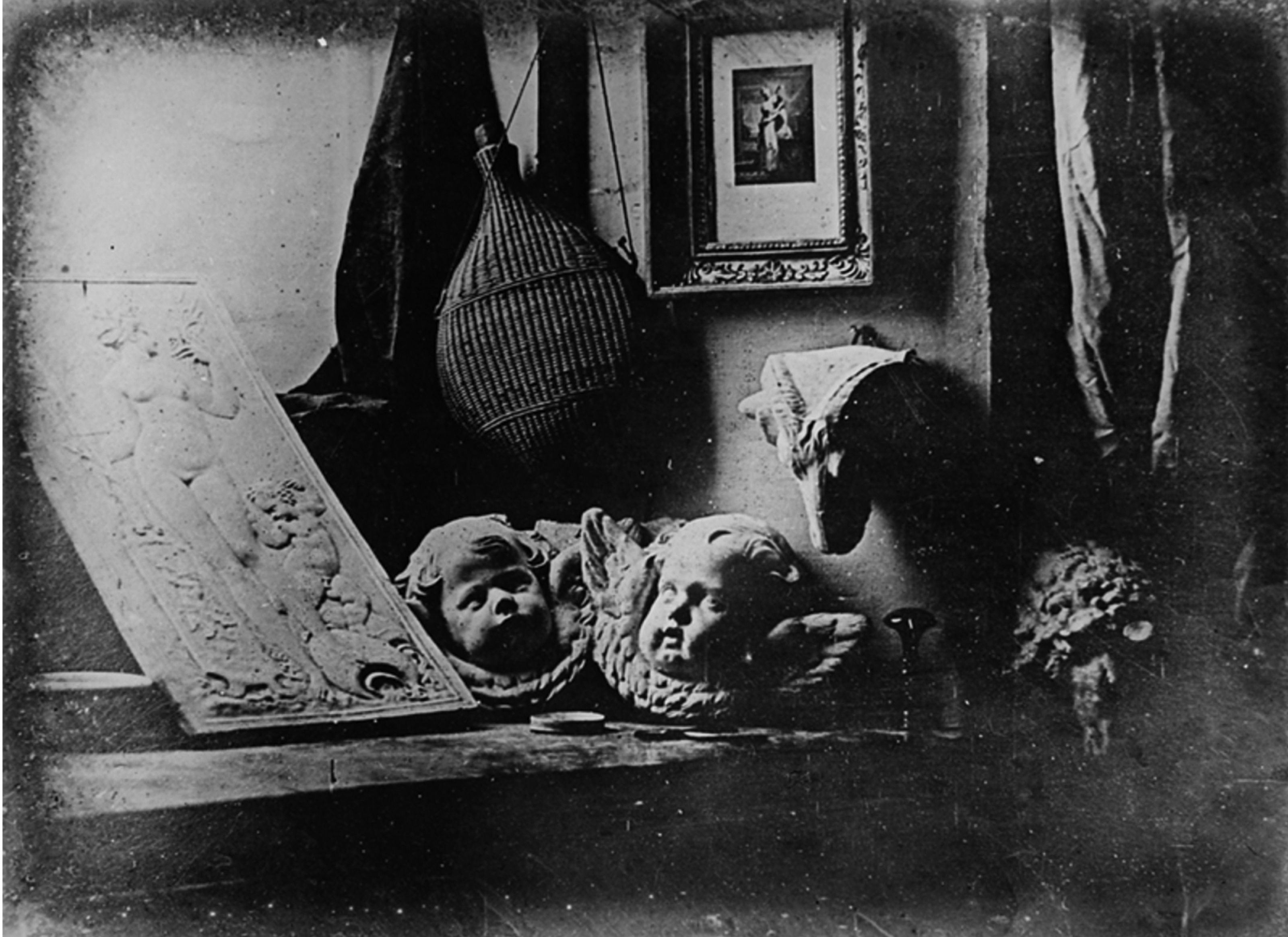
The next operation was to "fix" the photographic image permanently on the plate by dipping in a solution of hyposulphite of soda, often called "fixer" or "hypo", to dissolve the unexposed halides. Initially, Daguerre's process was to use a saturated salt solution for this step, but later adopted Herschel's suggestion of sodium thiosulphate, as did W. H. F. Talbot.
The image produced by this method is extremely fragile and susceptible to damage when handled. Practically all daguerreotypes are protected from accidental damage by a glass-fronted enclosure. It was discovered by experiment that treating the plate with heated gold chloride both tones and strengthens the image, although it remains quite delicate and requires a well-sealed enclosure to protect against touch as well as oxidation of the fine silver deposits forming the blacks in the image. The best-preserved daguerreotypes dating from the 19th century are sealed in robust glass cases evacuated of air and filled with a chemically inert gas, typically nitrogen.
Daguerreotype Proliferation
André-Adolphe-Eugène Disdéri and Jules Itier in France, and Johann Baptist Isenring in Switzerland, became prominent daguerreotypists. In the United Kingdom, however, Richard Beard bought the British daguerreotype patent from Miles Berry in 1841 and closely controlled his investment, selling licenses throughout the country and prosecuting infringers.Among others, Antoine Claudet andThomas Richard Williamsproduced daguerreotypes in the U.K.

Daguerreotype photography spread rapidly across the United States. In the early 1840s, the invention was introduced in a period of months to practitioners in the United States by Samuel Morse, inventor of the telegraph code. One of these original Morse Daguerreotype cameras is currently on display at the National Museum of American History, a branch of the Smithsonian, in Washington, DC. A flourishing market in portraiture sprang up, predominantly the work of itinerant practitioners who traveled from town to town. For the first time in history, people could obtain an exact likeness of themselves or their loved ones for a modest cost, making portrait photographs extremely popular with those of modest means. Notable U.S. daguerreotypists of the mid-19th century included James Presley Ball,Samuel Bemis,Abraham Bogardus,Mathew Brady,Thomas Martin Easterly,François Fleischbein, Jeremiah Gurney, John Plumbe, Jr.,Albert Southworth, Augustus Washington, Ezra Greenleaf Weld,] and John Adams Whipple.
This method spread to other parts of the world as well. In 1857, Ichiki Shirō created the first knownJapanese photograph, a portrait of his daimyo Shimazu Nariakira. This photograph was designated anImportant Cultural Property by the government of Japan.
The daguerreotype is commonly, erroneously, believed to have been the dominant photographic process into the late part of the 19th century in Europe. Evidence from the period shows that it was in widespread use for less than twenty years before being superseded by other processes:
- The calotype, introduced in 1841; a negative-positive process using a paper negative.
- The collodion wet plate process, introduced in 1851; a negative-positive process using halide-impregnated collodion poured from a bottle onto a glass plate and sensitized by immersion in a silver nitrate bath.
The collodion wet plate process was used to produce ambrotypes on glass and tintypes or ferrotypes on a coated iron plate.
- The ambrotype, introduced in 1854; a negative image on glass which appeared positive when on dark "ruby" glass or backed with a black varnish or cloth.
- The tintype or ferrotype, introduced in 1856; an image like the ambrotype, but on a thin blackened iron plate instead of glass.
Daguerreotype Demise
The intricate, complex, labor-intensive daguerreotype process itself helped contribute to the rapid move to theambrotype and tintype. The proliferation of these simpler and much less expensive photographic processes made the costly daguerreotypes less appealing to the average person (although it remained very popular inastronomical observatories until the invention of glass plate cameras). According to Mace (1999), the rigidity of these images stems more from the seriousness of the activity than a long exposure time, which he says was actually only a few seconds (Early Photographs, p. 21). The daguerreotype's lack of a negative image from which multiple positive "prints" could be made was a limitation also shared by the tintype, but was not a factor in the daguerreotype's demise until the introduction of the calotype. The fact that many of those to use the process suffered severe health problems or even death from mercury poisoning after inhaling toxic vapors created during the heating process also contributed to its falling out of favor with photographers. Unlike film and paper photography however, a properly sealed daguerreotype can potentially last indefinitely.
The daguerreotype's popularity was not threatened until photography was used to make imitation daguerreotypes on glass positives called ambrotypes, meaning "imperishable picture" (Newhall, 107).
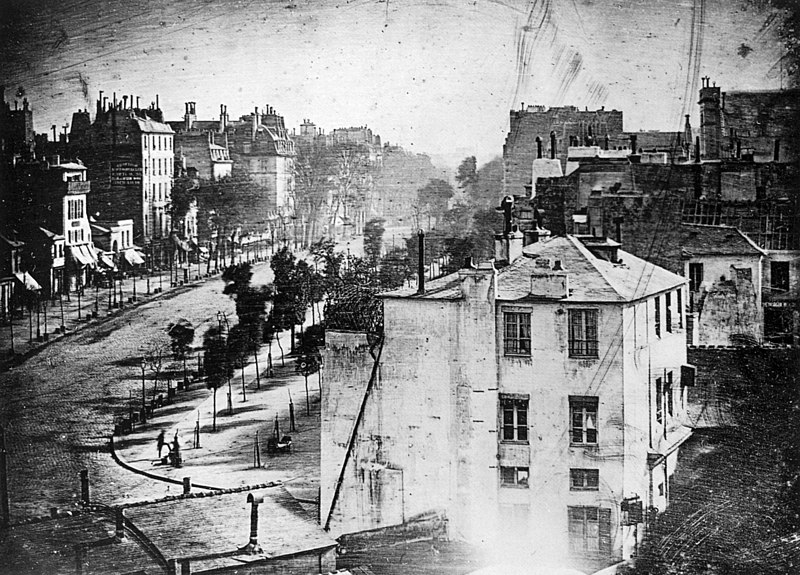 |
Boulevard du Temple by Daguerre |
Boulevard du Temple, Paris, 3rd arrondissement, Daguerreotype. The purportedly first picture of a living person. The image shows a busy street, but due to exposure time of more than ten minutes, the traffic was moving too much to appear. The exceptions are the two people at the bottom left, one who stood still getting his boots polished by the other long enough to show. Look closely and you will also see another man sitting on a bench to the right reading a newspaper. Also in the upper left hand side you can also see another man standing under the awning of the 3rd building from the left. What looks to be a woman standing under the street lantern at 10 o'clock from the man getting his shoes shined and another one in the big white building,1st row 3rd window down. Notice the child in the top floor window of the white building in front. Note that the image is a mirror image.
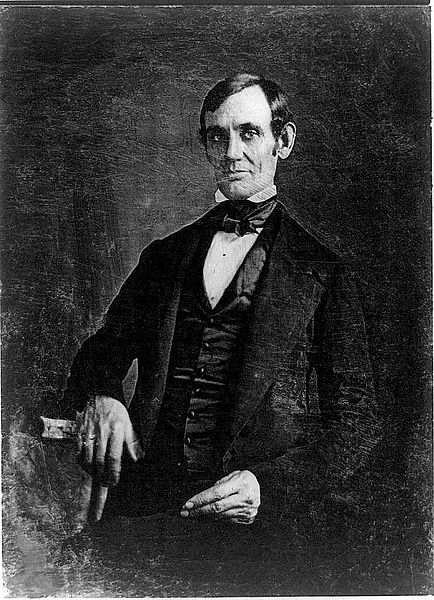
The first authenticated image ofAbraham Lincoln was this daguerreotype of him as U.S.Congressman-elect in 1846, attributed to Nicholas H. Shepard of Springfield, Illinois.
 |
Andrew Jackson-1844 |
Daguerreotype of Andrew Jackson at age 77 or 78 (1844 or 1845).
 |
| A daguerreotype of Shimazu Nariakira, taken by Ichiki Shiro (1828 - 1903) |
 |
| Photo panorama of San Francisco, 1853 |
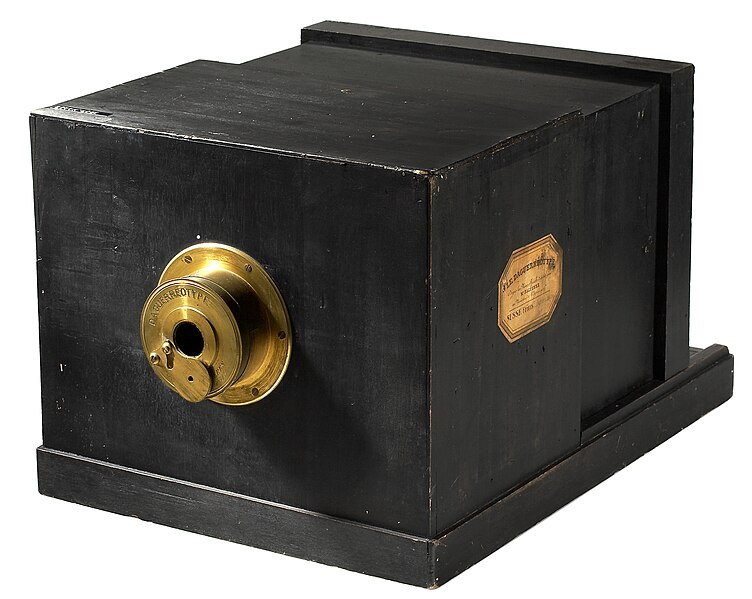 |
Susse Frére Daguerreotype camera 1839 |